The Three-Era Software History

Enterprise software has evolved in roughly the same way for several decades, with each generation solving the previous era’s biggest problem and creating a new one of its own. Each era digitized another piece of how organizations work. None of them ever managed to remove the burden of coordination from the people doing the work.
None of them ever managed to remove the burden of coordination from the people doing the work.
Era one: the mainframe monolith
The first era of enterprise software was built on the premise that a single vendor could deliver the full set of business processes an organization needed. One system, one database, one source of truth. The strength of that model was consistency. The weakness was that no single vendor could be deep across every functional domain — a platform that handled finance reasonably well might be thin in HR, weak in sales operations, or limited in manufacturing. The functional gaps that accumulated under the monolith are what triggered the next era.
Era two: best-of-breed specialization
If no single platform could be deep across every function, the answer was to let separate platforms specialize. Specialized applications — over time, platforms like Salesforce, Workday, and many predecessors in their respective categories — delivered better functionality in their domains than a general-purpose system could. Functionality improved across the board because each tool was designed for its specific use case.
The trade-off was that the organization still had to adjust itself to whatever logic each application enforced, and the application landscape as a whole fragmented. Data lived in silos, and the IT teams that had once consolidated work onto one mainframe now spent half their hours wiring together platforms that ought to have been speaking to each other already. To make the situation more workable, best-of-breed platforms introduced customization options — ways for organizations to tailor individual applications to their specific processes without changing the underlying code.
Era three: the customizable platform
The third era promised to make customization itself the foundation rather than a feature on top of separate applications. Configure the platform to match your processes. Adapt the software to the business rather than the business to the software. In theory, this resolved the prior eras’ problems at once.
In practice, implementation cycles stretched to three years. Requirements documented at kickoff were outdated by go-live. Consulting fees often equaled or exceeded the license cost, and the configurations IT teams stood up tended to break with every vendor update. The time and cost required to make the system fit the organization started to exceed the business value the system was supposed to deliver.
The time and cost required to make the system fit the organization started to exceed the business value the system was supposed to deliver.
The pattern enterprise leaders recognize
Across all three eras, the underlying problem is the same. The organization has had to adjust itself to whatever the software was capable of delivering, and the coordination work between systems has continued to land on the person. Mainframes resolved depth by forcing the organization onto a single platform’s logic. Best-of-breed resolved depth by introducing specialized platforms, but at the cost of fragmentation and the customization burden that came with adapting each system. Customizable platforms tried to absorb the customization burden into the platform itself and produced implementations whose cost and time often outran their business value.
The result is visible in the data. Deloitte’s 2026 research found that only 4% of finance teams have fully automated accounts payable despite decades of ERP investment. The gap between what enterprise software is supposed to deliver and what it actually moves end-to-end across systems is still wide.
Where the pattern can end
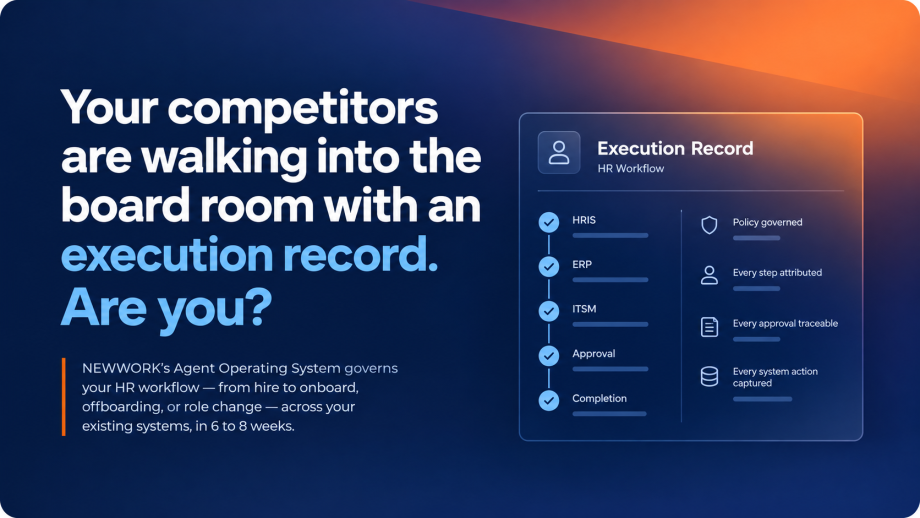
NEWWORK is built to bridge the gap between fragmented systems, breaking the pattern the prior eras kept producing. Value packs handle approximately 90% of common workflows out of the box, with the remaining 10% configured inside defined API guardrails that the platform enforces. This brings today’s AI possibilities to bear on tailoring workflows and functionality within a single platform, which gives the organization integration across the systems already in place, plus a workflow tailored to the way the business actually operates, without the customization hell that derailed the prior era. Because every configuration is done according to clear interfaces with the platform, customizations stay within boundaries that protect the upgrade path and governance controls.
That is a different shape of enterprise software than what the prior eras produced. For the first time in several decades, integration, fit, and supportability stop being a trade-off the organization has to absorb.