Why ‘Application’ Is the Wrong Word Now

Enterprise software has spent several decades moving work from paper to pixels. What it has never managed to remove is the coordination work between systems, which still lands on the person. Every platform an enterprise runs today — ERP, HRIS, workflow tools, AI copilots — digitized its piece of the process without finishing the job.
The word “application” carries a particular kind of baggage for enterprise buyers because of this history. When a CIO or CHRO hears “application,” what comes to mind is often hard-coded logic, pre-decided functionality, and the immediate question of how to work around what the vendor has already decided. The instinct didn’t develop in a vacuum. It was built by decades of discovering which workflows the platform did and didn’t support, which custom fields would survive the next upgrade, which approvals routed through someone who left the company two reorgs ago, and which reports needed a middleware layer to produce.
That instinct is now running up against a different reality. The conditions that made the word “application” useful for enterprise buyers are no longer the conditions they are operating in.
What changes when AI can build features on demand
Enterprise buying decisions have historically rewarded the platform with the longest feature list. That math is starting to shift. When AI can stand up a working interface, a workflow, or a report on demand, the value of pre-packaged features goes down considerably. The question that used to dominate the RFP — does the platform do X — has become a smaller part of the conversation.
What hasn’t become trivial is whether the result of AI activity can be trusted. Gartner Q2 2026 reported that 59% of IT leaders see little or unclear value from current AI investments, and research from Nokod the same year found that security teams have visibility into only 44% of the enterprise AI automations already running in their environments. The technology is producing results. The execution layer that governs how it operates is what is missing.
This reframes the buying decision. Feature list parity is fading as a deciding factor in platform selection, and implementation timeline along with it. The updated central question for enterprise buyers is which execution layer can govern how AI uses features across the organization. Governance — access rights, policy enforcement, audit trails, approval routing — used to be the back-of-the-deck slide in an enterprise software pitch. It is increasingly the whole deck.
How value packs work differently from applications
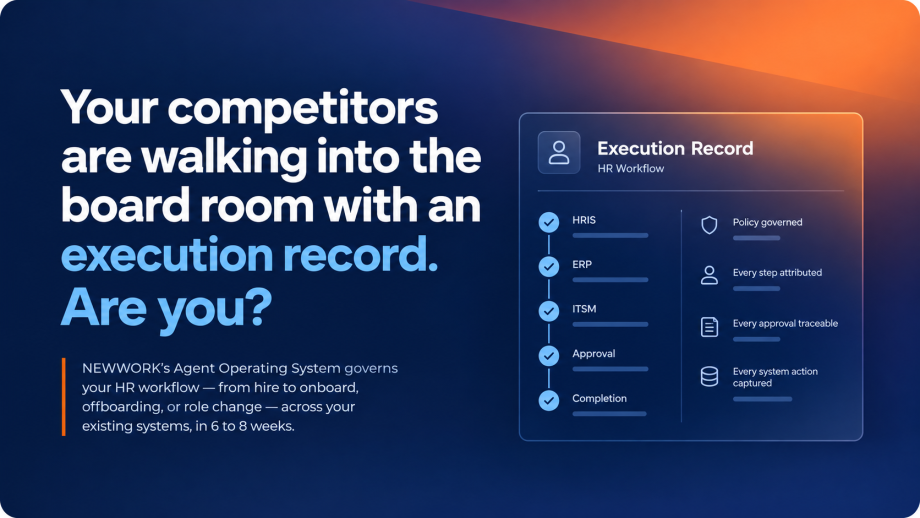
Consider how a hire-to-onboard workflow plays out in practice. About 90% of the steps look the same across most organizations: account provisioning, equipment ordering, payroll setup, benefits enrollment. NEWWORK’s value pack handles those out of the box. The remaining 10% — the company’s particular approval chains for senior hires, the team-specific access patterns, the document signatures required in a given jurisdiction — is configured inside defined API guardrails. The platform enforces those guardrails, which means customizations cannot break the upgrade path or bypass governance controls.
Traditional customizable platforms worked in the other direction. They gave organizations the freedom to build anything they wanted, including the thing that would break on the next upgrade, create the audit finding, or consume more maintenance budget than the original implementation cost. That freedom became the source of the technical debt. Value packs invert the relationship. The organization shapes the workflow inside boundaries the platform protects, which is functionally different from what an application offers.
What replaces the application
What ends with the application as a category is the assumption that enterprise software deployment requires the organization to adapt its operations to the vendor’s idea of best practice. The three-year implementation cycle ends with it, along with the choice between speed and fit, and the instinct built over decades that the vendor decided and the buyer’s job was to circumvent.
What replaces it is execution infrastructure: governed AI that orchestrates above the systems already in place without replacing them, value packs that move work from intent to outcome inside the organization’s own policies, and a buying decision that rewards governed execution rather than feature breadth.
The word “application” was always shorthand for “the vendor decided.” For the first time in decades, enterprise buyers have a different option on the table.