The CFOs Making AI ROI Visible Started with a Baseline.
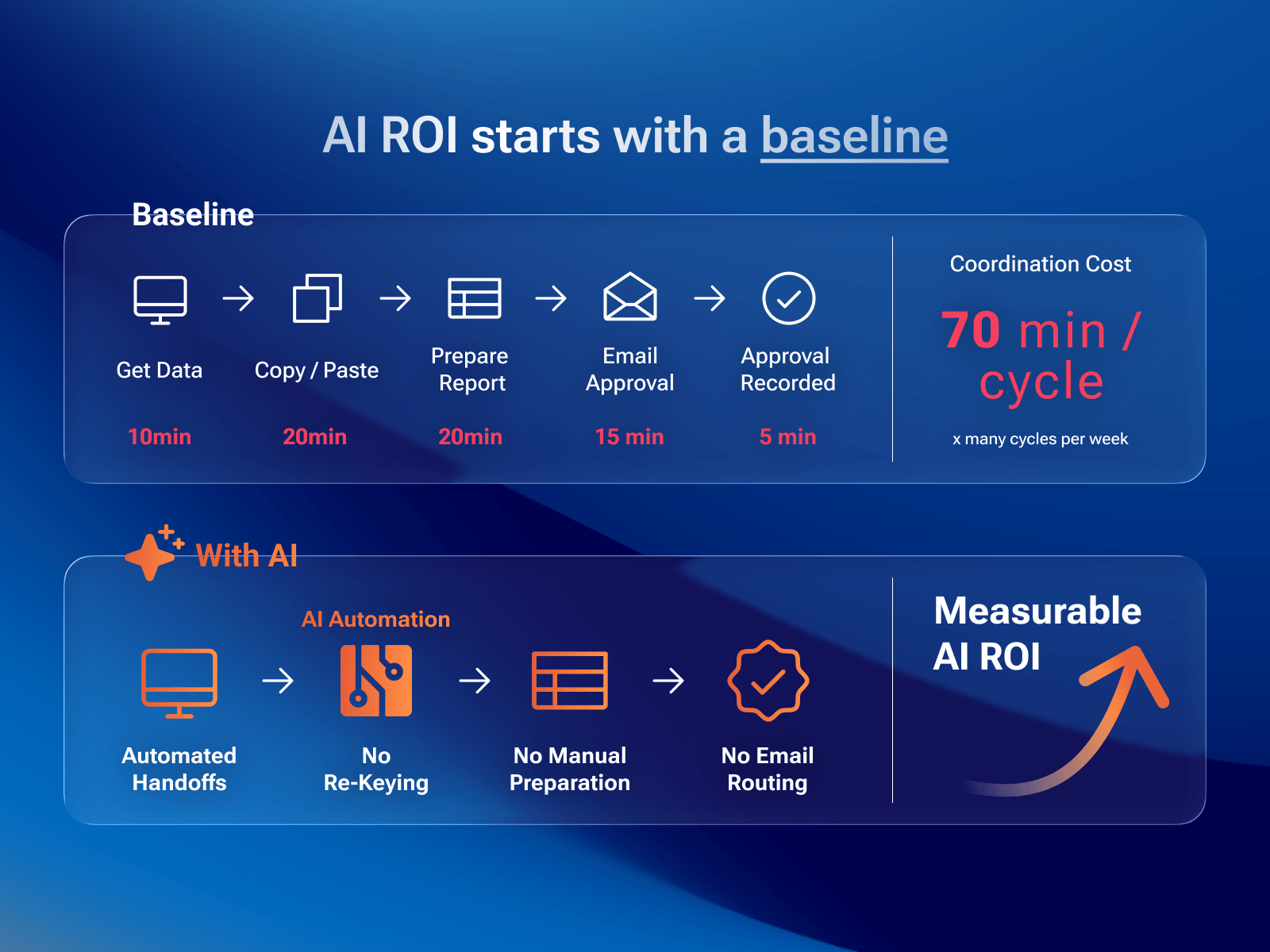
The AI budget is approved. The tools are running. The spend is real. The enterprises where the return is visible on the P&L share a common starting point: they documented the cost the AI was going to displace before the deployment began. That cost is coordination overhead – the manual work that holds disconnected systems together. It has been in the P&L for years, funded through headcount and classified as finance, HR, or operations work. The CFOs who surface it before the next board AI ROI conversation have a measurement to work from and a return to show. Let’s look at what that baseline captures.
What coordination cost looks like inside the enterprise
Every enterprise runs a category of work that exists solely to move information between systems that were built independently and never designed to connect. Someone re-keys invoice data from a supplier portal into the ERP. Someone exports a report from the HRIS, reformats it, and pastes it into a finance model. A third person routes an approval request by email because the system that generated the request and the system where the approval needs to be recorded are two separate tools with no integration between them.
This work is distributed across dozens of roles and hundreds of recurring tasks. It produces no strategic output and generates no margin. It bridges a gap in the architecture, and it has been classified as finance work, HR work, or operations work for so long that no one has separated it out as its own cost category. The cost is real. Quantifying it is what makes AI’s displacement of it measurable.
Why establishing the baseline first changes the return calculation
Coordination cost is measurable before the AI runs: manual steps per workflow, systems touched, time per cycle, headcount hours per week. When that baseline is documented before deployment begins, the AI produces a before-and-after the board can read. The spend maps to a specific, traceable cost reduction in a specific workflow. The return is not a projection – it is a comparison between two measurements taken at different points in time.
The CFOs who establish that baseline are also the ones who can answer the board’s actual question. Not “will AI deliver a return,” but “what did it displace, where, and by how much.” The coordination cost was always there. The baseline is what makes the answer visible.
What the deployment record shows
NEWWORK’s deployment model starts with that baseline. The coordination cost in a selected workflow is quantified before deployment begins. The FLOW execution record at the end of the engagement shows what the AI did, what it displaced, and what the workflow looks like now. The CFO gets a traceable return tied to a specific cost reduction – a before-and-after grounded in a measurement taken before the deployment started.
The first move is naming the cost
Coordination cost has been in the P&L for years. Surfacing it before the next board AI ROI conversation is the move that converts AI spend from a capital commitment into a documented return. The cost is there. It has always been there. Establishing the baseline before the deployment starts is what makes it count.