The CHRO Seat Just Got Bigger. The CHROs Who Fill It Have an Execution Record.
The CHRO Seat Just Got Bigger. The CHROs Who Fill It Have an Execution Record.
IBM’s 2026 CEO Study puts a specific number on a shift that’s already underway: 59% of CEOs expect the CHRO’s influence to expand over the next three years because of AI. The CHROs translating that expectation into board-level standing share a common advantage. They can produce a documented account of how AI governed a specific decision – which systems were involved, where human judgment applied, and what the record shows. That’s not a roadmap. It’s proof.
The path to that artifact is more accessible than most HR functions have assumed. It starts with a single cross-system workflow, running on existing infrastructure, with governance built in from the start. Let’s look at what makes it possible.
Where the CHRO’s credibility is built
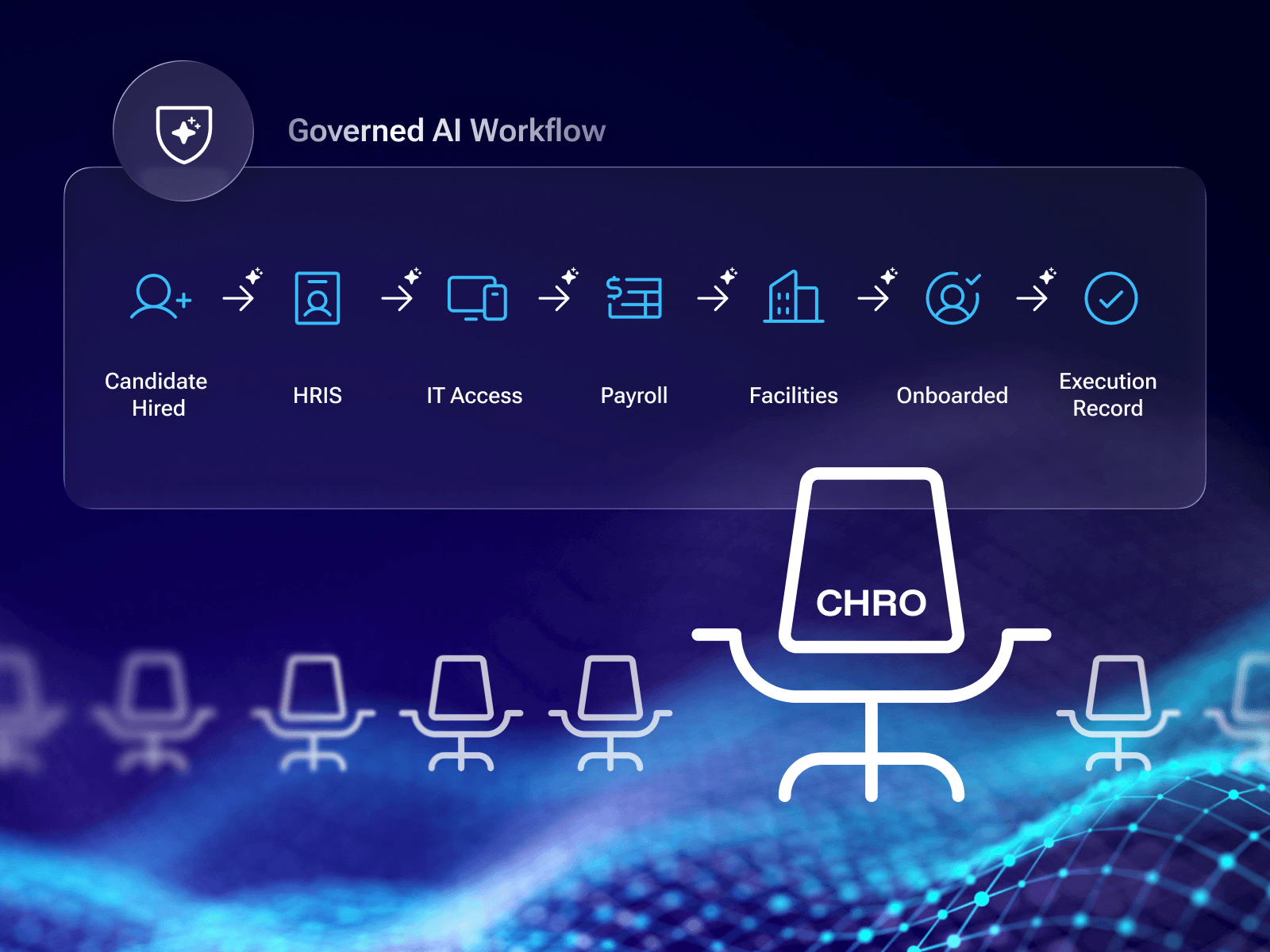
The hire-to-onboard process crosses HR, IT, payroll, and facilities. So does offboarding. So does every role-change workflow. Those processes don’t live inside any one system – they move across all of them. HRIS and ERP platforms have added AI capabilities steadily, and most large HR organizations are running several. Those capabilities work well within individual system boundaries.
The handoffs between systems – where approval logic crosses team lines and no single platform holds the full picture – are where the CHRO’s governance claim either holds or doesn’t. The CHROs who can demonstrate governance at that layer are the ones who can answer the board’s actual question: not “do your tools have AI,” but “how did AI influence this decision, and where is the record.”
What a governed cross-system workflow produces
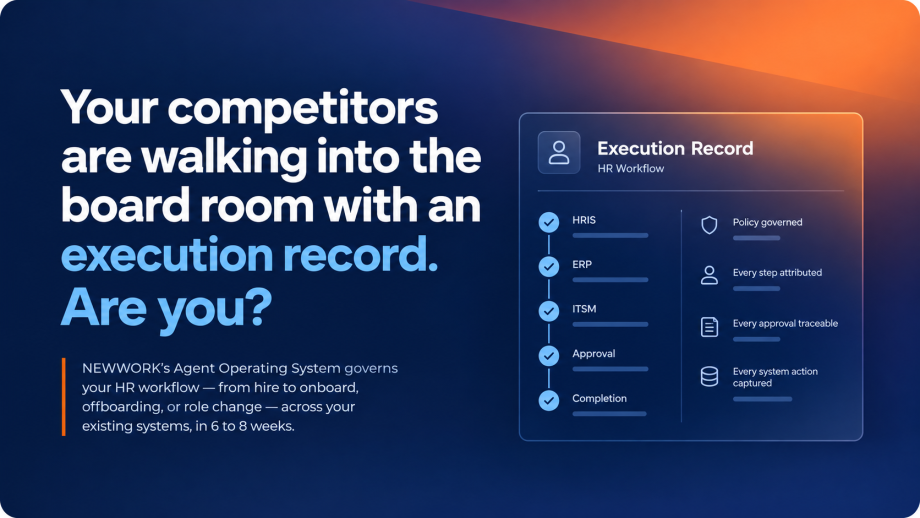
An orchestration layer that carries work across existing systems – capturing a record at every step, applying approval logic where the CHRO’s governance model requires it, escalating to human judgment when policy says it should – produces something a vendor roadmap cannot: an auditable account of how a process actually ran.
That account answers the board. It answers the works council. It answers the CFO. And it does it without asking the CHRO to replace the systems already in place. The infrastructure is existing. The governance logic is the CHRO’s. The execution record is automatic.
One workflow changes the conversation
A single workflow – hire-to-onboard is the most common entry point – deployed in six to eight weeks, is sufficient to produce the artifact. The before-and-after is measurable. Coordination time drops. Handoff failures surface and resolve. The execution record is available from day one.
The CHRO takes that record to the board – not a projection of what AI will eventually do, but a documented account of what it already did, inside a process the CHRO owns, under policies the CHRO controls. That’s the asset that fills the seat.