The Governance Gap Is Structural – and CIOs Who Name It First Move Fastest
Enterprise AI has moved past the demo.
Across the Fortune 500, digital employees are no longer sitting in a sandbox waiting for sign-off. They are reading from production systems, writing to them, and making calls that touch finance, HR, and customer data. The enterprises pulling ahead are not the ones with the most agents in flight. They are the ones who built governance into the execution layer before they scaled – and that decision starts with the CIO.
The instinct is to treat governance as a tooling problem: buy a monitoring product, add a policy layer, move on. The CIOs closing the gap fastest have a different read. They name it as a structural issue first, then build the architecture to match. Let’s look at where that architecture actually matters.
Where governance needs to operate
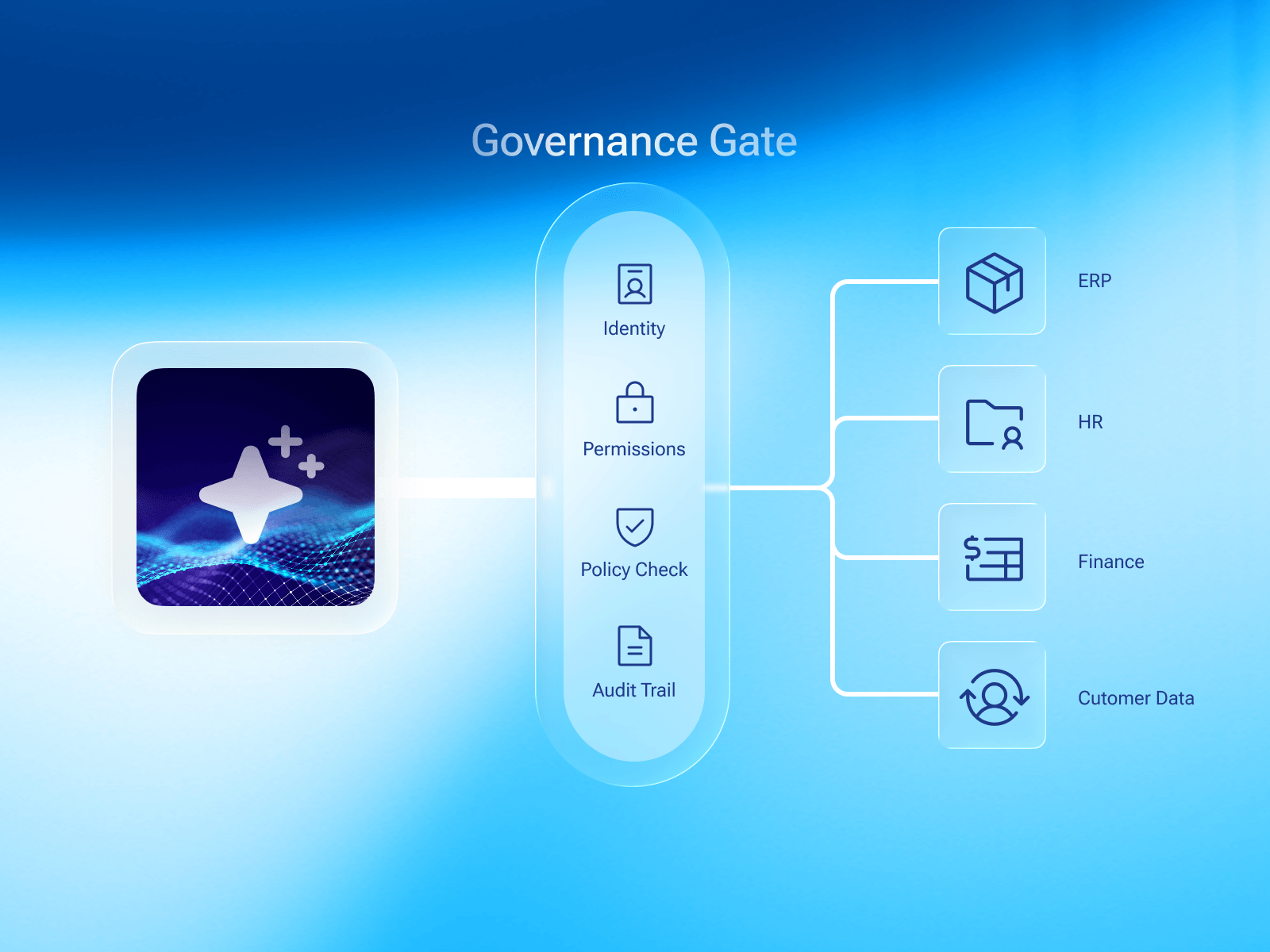
Governance does not fail all at once. It becomes visible at the system boundary – the point where a digital employee stops reasoning and starts executing against a live system of record. A digital employee that summarizes tickets is straightforward to deploy. The same digital employee, once it updates the ERP, changes an entitlement, or pushes a payment, operates in territory where every action carries a consequence and a record someone is accountable for.
The enterprises building durable AI programs have structured this boundary deliberately. Every digital employee has a defined role, an owner, permissions scoped to its function, policy checks before execution, and a full audit trail. That structure is what allows the program to scale. Without it, each new deployment is another ungoverned action running across systems the CIO is responsible for.
The visibility problem is solvable
A 2026 survey of 200 enterprise CISOs found that security teams have full visibility into only 44% of the apps, agents, and automations created by business users. That number reflects programs built without a structured governance layer underneath them. The same research found business users now outnumber professional developers by as much as 10 to 1, which means the ungoverned share grows with every deployment cycle.
The CIOs who are ahead of this are not trying to slow the deployment rate. They are building the infrastructure that makes high deployment rates safe – an Agent Operating System that gives every digital employee identity, permissions, policy scope, and traceability as a baseline, not a retrofit.
Scale rewards the CIOs who built the foundation early
Gartner projects that by 2028 the average global Fortune 500 enterprise will run more than 150,000 digital employees, up from fewer than 15 in 2025. That growth rate makes the architecture decision made today consequential at a scale most organizations have not yet modeled. A governance layer built for 15 digital employees and extended incrementally to 150,000 holds. A patchwork of monitoring tools and after-the-fact policy reviews does not.
The CIOs making that investment now are also the ones best positioned to answer the governance question boards are already raising: who approved this action, what did it touch, and can you prove it followed policy. Having that answer ready is not just a risk management story. It is the operational proof that
AI ROI is real and defensible.
The framing decides everything that follows
The governance gap is not a future risk to queue for a later roadmap cycle. Enterprises running AI at scale today, without an Agent Operating System underneath their execution layer, are accumulating accountability exposure with each deployment. Naming it as a structural problem – rather than a collection of individual tooling gaps – is the decision that unlocks the right architecture. CIOs who make that call early build AI programs that compound. The alternative is spending the next two years mapping what was built and accounting for what it did.
Sources
Nokod 2026: Security teams see only 44% of enterprise apps, agents, and automations
Gartner 2026: Fortune 500 enterprises to run 150,000+ digital employees by 2028