Why Most AI Solutions Fall Short in the Enterprise

Enterprise expectations about AI have been shaped over the last two years largely by tools that were not built for enterprise environments in the first place. They were built for consumers or for lightweight productivity use cases, and they rely on public models, external data flows, and reasoning processes that organizations cannot fully see, much less control. When those tools cross into an enterprise environment, the gaps become obvious quickly.
The list of concerns is familiar to anyone who has tried to deploy AI inside a regulated organization. Sensitive information moves to places the company did not authorize. The reasoning behind a recommendation is opaque, which makes it hard to explain when a board or a regulator asks. Data access boundaries blur because the AI tool was not designed to respect an org chart. The tool has no awareness of internal policies, no audit trail, and a tendency to invent information when its training data does not reach far enough. For consumer use cases, these are friction. For enterprise use cases, they are blockers.
The data backs up what enterprise leaders are already seeing in practice. Harbr Data’s 2026 research found that 61% of large enterprises cannot fully explain how their sensitive data is being used by AI systems operating on their behalf, and Nokod’s 2026 figures put security team visibility into enterprise AI automations at only 44%. The volume of AI activity is going up, the visibility into what it is doing is going down, and the leaders accountable for the resulting risk are being asked to approve more of it.
That tension is what makes the conversation about enterprise AI different from the conversation about AI generally. The intelligence of the model matters less, at this stage of the category, than the architecture around it. Enterprise-ready AI has five foundational requirements, each of which addresses a specific reason consumer-grade tools tend to fail when they cross the enterprise boundary.
The volume of AI activity is going up, the visibility into what it is doing is going down, and the leaders accountable for the resulting risk are being asked to approve more of it.
AI grounded in verified enterprise knowledge
Trustworthy AI starts with trustworthy information. NEWWORK Enterprise AI uses verified internal knowledge — company documentation, approved policies, business systems, controlled data sources — as the basis for research, reasoning, and decision-making, unless it is explicitly instructed to include external resources.
That single architectural choice changes the operational character of the AI in a meaningful way. Instead of generating an answer based on public internet content of uncertain provenance, the AI operates on what the organization itself has approved as its source of record. Enterprise search returns results that match how the business is actually organized. Workflow automation runs against policies the organization has signed off on. Decision support is explainable because the underlying source is internal and verifiable.
For compliance-sensitive operations in particular, this grounding is what makes the difference between AI that can be trusted to operate autonomously and AI that cannot. Without it, the question of whether to let the system act on its own answers is, in practice, unanswerable.
AI that understands organizational context
Enterprise environments are not flat. Data sits across systems, teams, classification levels, and permission structures, and much of the most important information is unstructured — buried in documents, presentations, conversation threads, and emails sent six months ago. An AI tool designed for consumer environments has no model of any of that.
NEWWORK Enterprise AI is built to understand the organization it is operating in: the structure of teams and reporting lines, the policies that govern how information is handled, the confidentiality classifications attached to documents, and the access patterns that distinguish a senior leader’s view of a record from a contractor’s view of the same record. The system can identify sensitive content inside unstructured material — a draft contract, an internal memo, an HR file — and apply the appropriate governance controls without waiting for a human to flag it.
That contextual intelligence is what distinguishes an enterprise AI capability from a generic assistant. A capability operates inside the organization’s logic. An assistant operates outside it and hopes the user catches the mistakes.
AI governed by enterprise security and permissions
One of the most persistent enterprise concerns about AI is uncontrolled access. The standard objection — what stops the AI from reading something it should not? — has historically been answered with custom guardrails, manual reviews, or scope limitations that quickly become unmanageable as the AI’s use cases expand.
NEWWORK Enterprise AI handles this at the architectural level. AI agents operate within the same security context as the human employees they support. If a user does not have access to a document, the AI acting on their behalf does not have access to that document either. Existing roles, permissions, and access rights apply to the agent in the same way they apply to the person. The enterprise’s existing governance model becomes the AI governance model.
The benefit, beyond reducing the security surface, is that the organization does not have to stand up a separate AI permissioning system that diverges from its core identity infrastructure over time. Compliance becomes simpler because the answer to “who and what can the AI access?” is the same as the answer to “who and what can the user access?”
If a user does not have access to a document, the AI acting on their behalf does not have access to that document either.
Audited AI execution with human oversight
Enterprise AI cannot be a black box. The board, the audit committee, and increasingly the regulator all need to be able to ask what decisions the AI made, why it made them, what information it used, and where humans were involved. Barron’s 2026 captured the broader version of this question in five words: if an AI agent makes a mistake, who is responsible?
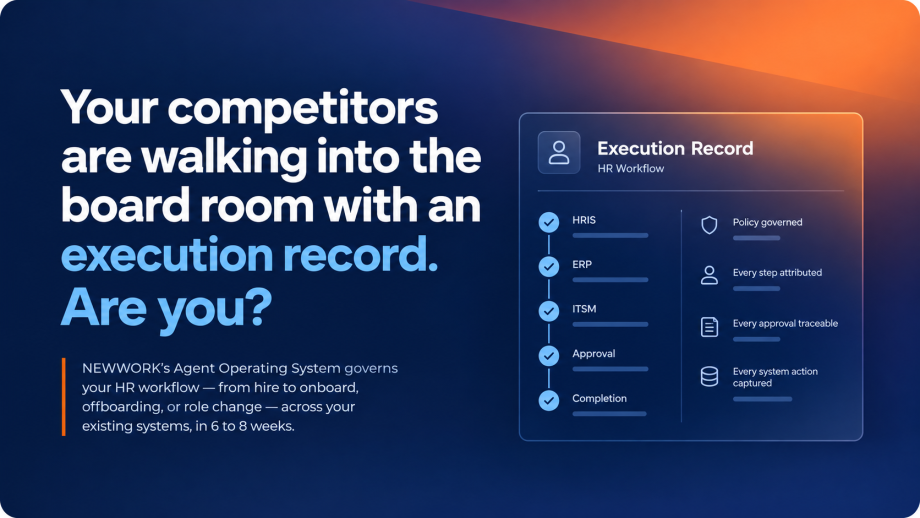
NEWWORK Enterprise AI provides audited execution with human oversight built into the architecture rather than bolted on after the fact. Every AI-driven decision is monitored, logged, explainable in natural language, and reviewable by a human. Confidence thresholds determine when a decision should escalate to a human reviewer before it executes, which gives the organization a clear, configurable line between autonomous action and human judgment.
The combination of full execution records and configurable human-in-the-loop is what allows AI to accelerate operational work without surrendering accountability. The organization keeps the governance. The AI carries the coordination.
The organization keeps the governance. The AI carries the coordination.
Private by architecture
Privacy is not a feature that can be added on top of an AI system after deployment. It has to be designed in.
NEWWORK Enterprise AI keeps sensitive data inside the organization’s own environment. Enterprise information is not transmitted to public AI models for processing, and the customer’s data remains under the customer’s control throughout the operational lifecycle. For industries operating under regulatory requirements — financial services, healthcare, public sector, regulated manufacturing — this architectural choice is what makes AI deployable at all. For organizations with intellectual property concerns or customer data obligations, it is what keeps a deployment from creating new liability while solving an old one.
The trade-off enterprises were previously asked to accept — adopt AI now and figure out the privacy implications later — is one enterprises should not have to make. With the right architecture, the choice between AI innovation and data privacy collapses into a single decision.
From experimentation to operations
The pattern of enterprise AI adoption is shifting. The early phase — isolated chatbots, departmental copilots, individual productivity experiments — produced learning, but it did not produce operational capability. The next phase requires systems that can operate securely across the enterprise, understand organizational context, follow governance rules, respect permissions, explain their decisions, collaborate with human workers, and protect sensitive data.
That is the foundation enterprise-ready AI requires. Without it, AI in the enterprise stays in pilot mode indefinitely. With it, AI becomes part of how operational work actually runs.
At NEWWORK, the architecture has been built specifically for that transition, enabling enterprises to adopt AI confidently, securely, and at the scale operational systems actually need.