How to Make AI ROI Visible to Your Board: The Structural Answer
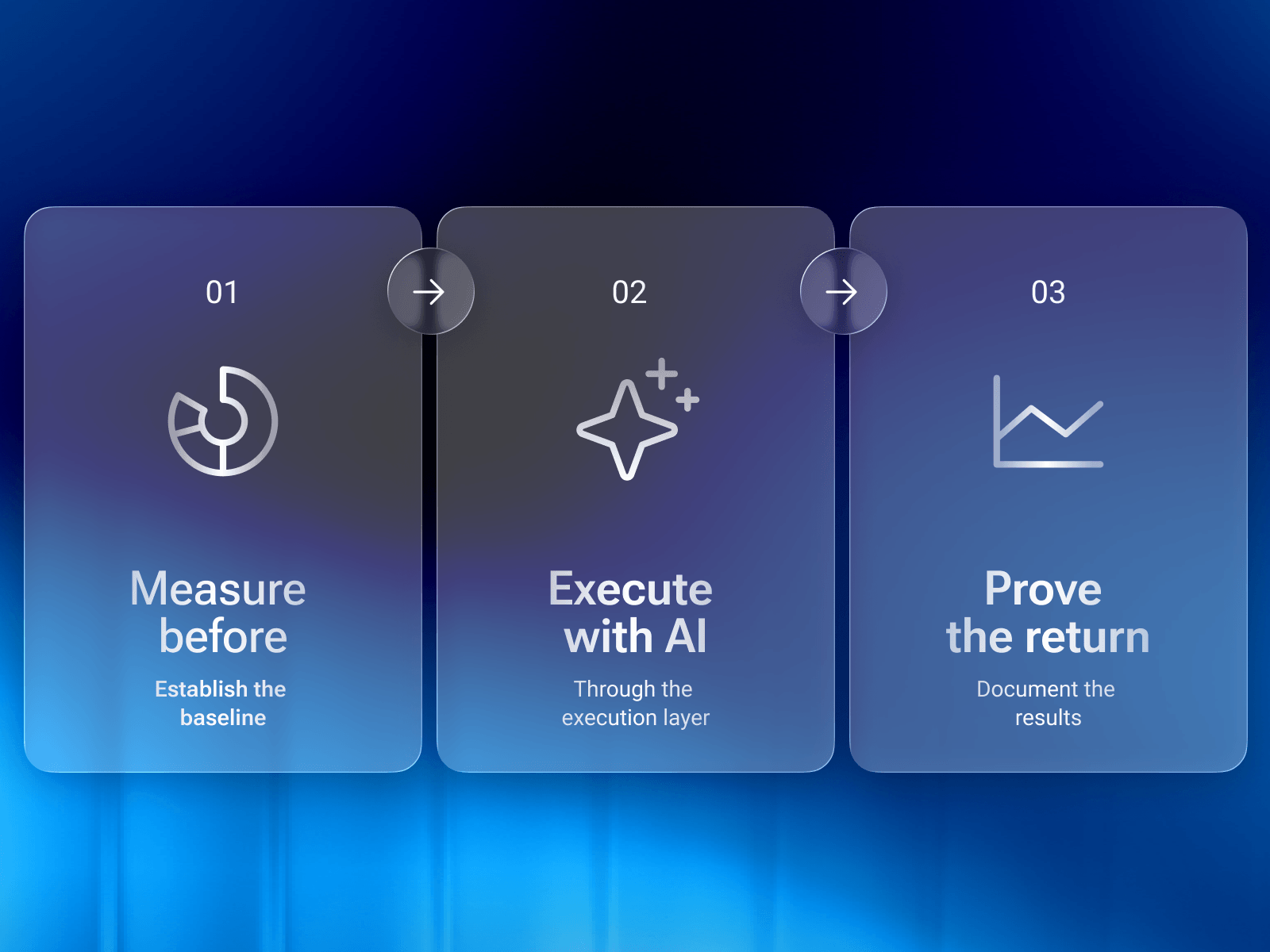
The board’s AI ROI question has a structural answer, and it is available to any CFO who builds the right deployment model from the start. The CFOs who can answer it have three things: a quantified baseline established before the AI ran, an execution record that shows what changed, and an audit trail documenting every AI action taken against the workflow. Those three things constitute a before-and-after the board can read without translation.
Let’s look at what makes each of those elements possible and how they connect.
Where the AI return actually comes from
AI tools generate decisions. They classify invoices, flag anomalies, draft approvals, summarize data, and recommend actions. The return on those decisions is realized when they connect directly to the enterprise systems where they need to result in action – without a human handling each transition. That connection is what the execution layer provides.
When AI decisions route through the execution layer to the ERP, the HRIS, or the finance system, the coordination work that would otherwise land on headcount is absorbed by the FLOW engine. Cycle times fall. Headcount that was bridging AI output to systems of record is freed for higher-value work. The coordination cost is displaced, and the displacement is measurable because the baseline was established before the deployment started.
What the execution layer connects
The governed execution layer is the infrastructure that carries AI decisions from recommendation to action to system record to audit trail. An AI that recommends an invoice approval delivers P&L impact when that recommendation connects directly to the approval system, triggers the ERP posting, and logs the outcome. Without that connection, the AI is a decision support tool. Decision support is valuable. It leaves headcount in place, cycle times unchanged, and the coordination cost exactly where it was.
NEWWORK’s Agent Operating System is that governed execution layer – with the FLOW engine connecting AI decisions to the enterprise systems where those decisions need to result in action, governed by policy, logged for audit, and recoverable if something goes wrong. The coordination work between the AI and the system of record is absorbed by the FLOW engine.
Why the baseline is what makes the return visible
The CFO who can answer the board’s AI ROI question started with a baseline. The coordination cost in a specific workflow was measured before the AI ran: manual steps, systems touched, time per cycle, headcount hours per week. With that baseline, the deployment produces a before-and-after the board can read. The AI spend maps to a specific, traceable cost reduction in a specific workflow.
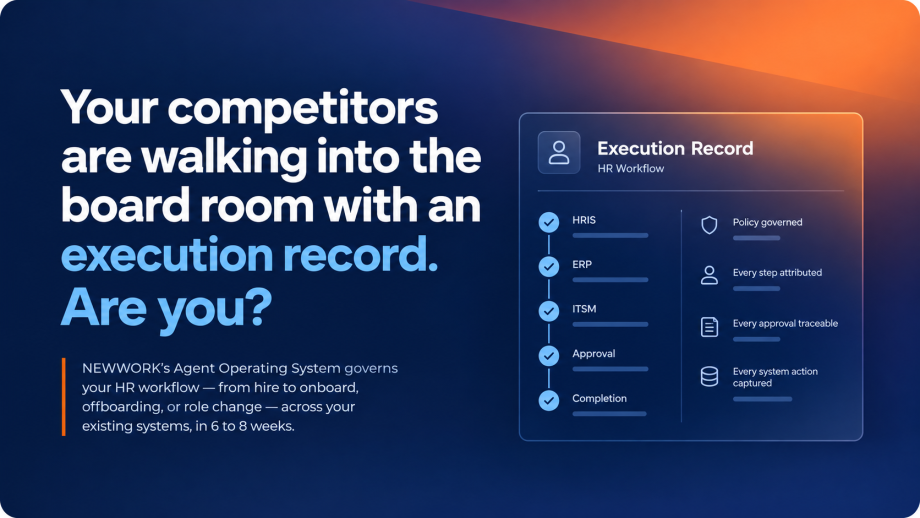
NEWWORK’s deployment model produces all three elements by design. Every deployment starts with a quantified baseline. The FLOW execution record is board-presentable by default – a structured account of what the AI did, what it displaced, and what the governance of each action looked like. The CFO gets a traceable return tied to a specific workflow, grounded in a measurement taken before the deployment started.
The board question is answerable
The CFO who has the baseline, the execution record, and the audit trail can answer the board’s AI ROI question in the next budget cycle. The answer is not a projection. It is a documented comparison between two states of the same workflow, with the AI’s actions logged and the cost displacement measured. That is the structural answer – and it is the only one that holds.