The Second AI Budget: Where CIOs Who Are Moving Fast Are Finding the Funding

The AI line item is approved, and the board thinks it should be bigger. The CIO knows exactly why it isn’t. Reporting from DesignRush, drawing on Accenture’s 2026 banking research, puts the figure at up to 70% of IT budgets consumed by maintaining legacy systems and managing technical debt. The money is not idle. It is committed to systems other teams depend on every day, and the CIO owns the consequence if any of them slip.
The CIOs who are moving past this constraint have found a second budget inside the enterprise that has always existed and never appeared as a line item. Quantifying it before the AI deployment starts is what makes the return traceable afterward – and what changes the board conversation from budget justification to documented return.
Where the second budget lives
Inside most enterprises, a substantial volume of work exists solely to move information between systems that were never designed to connect. Someone re-keys invoice data from a supplier portal into the ERP. Someone exports a report from the HRIS, reformats it, and pastes it into a finance model. A third person routes an approval request by email because the system that generated it and the system where it needs to be recorded are two separate tools with no integration between them.
This work is distributed across dozens of roles and hundreds of recurring tasks. It produces no strategic output, generates no margin, and has been classified as finance work, HR work, or operations work for so long that no one has separated it out as its own cost category. It is real spend, and it is already in the budget. It just has no row of its own.
Why the reallocation argument misses the point
The standard response to the 70% constraint is to move budget from maintenance into AI. In practice, every dollar moved comes out of a system someone is depending on, and the CIO is accountable when that system degrades. The NASSCOM 2026 leadership forum framed the same dynamic: as AI adoption scales, the complexity of keeping older architecture stable rises alongside it rather than falling away. Reallocation without a displacement story trades one liability for another.
The coordination cost approach is different. Displacing the manual work that holds disconnected systems together does not destabilize the systems themselves. It frees budget that was already being spent, without removing support from anything that breaks if it loses it. The AI deployment funds itself out of the work it displaces. That is the model the board can read without asking the CIO to defend a net-new budget request.
What the self-funding model requires
The move that makes this work is establishing the baseline before the deployment starts. Coordination cost is measurable: manual steps per workflow, systems touched, time per cycle, headcount hours per week. When that number is documented before the AI runs, the deployment produces a before-and-after the board can read. The AI spend maps to a specific, traceable cost reduction in a specific workflow.
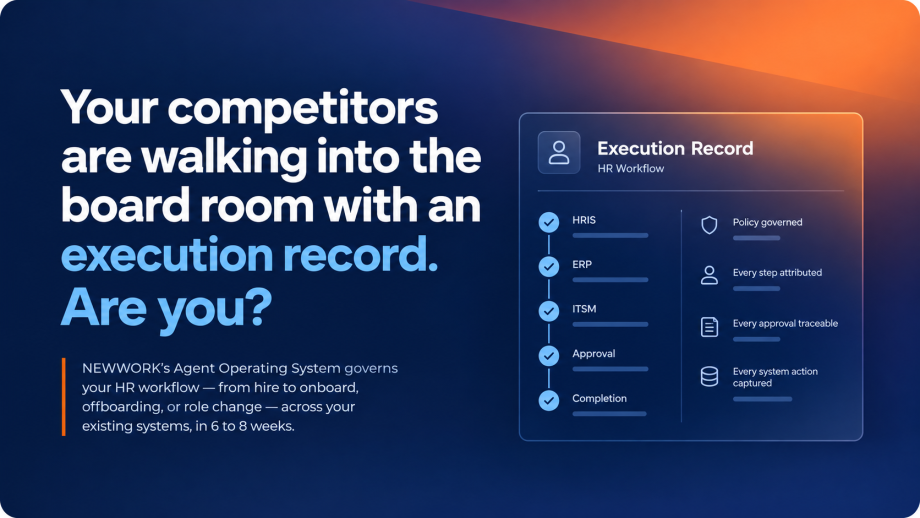
NEWWORK starts there. The coordination cost in a selected workflow is quantified before deployment begins. The FLOW engine execution record at the end of the engagement shows what the AI did, what it displaced, and what the workflow looks like now. The CIO takes that record to the board – not a projection, not a line-item request, a documented return tied to a cost that was already being paid.
The funding question comes before the architecture question
The 70% constraint is real, and the pressure to increase the AI line item is not going away. The CIOs who have solved it did not find new budget. They found the budget that was already there, gave it a number, and structured a deployment that runs against it. That is the model that converts the AI conversation at the board level from a request into a return.
Sources
DesignRush / Accenture Banking Trends 2026: up to 70% of IT budgets consumed by legacy and tech debt