Start With Your Systems. We Will Bring the Workflow.
You name the systems you want governed execution proven across. NEWWORK identifies the workflows that already run between them, proposes the one that exercises the architecture most completely, and runs it end to end in six to eight weeks.
Why the workflow is chosen this way.
The point of a first deployment is to show you whether governed execution holds up across your landscape. NEWWORK proposes against four architectural criteria. The workflow crosses at least two Systems of Record. It hits a real policy boundary. It contains an exception that has to route to a human. And it includes a step that has to be reversed.
Reversal is the criterion that decides whether the test proves anything. Every execution layer looks competent creating an account. The difference shows up when a five-system termination sequence fails at step four and leaves an account half-deprovisioned, when a rollback has to return the environment to a known good state, and when an auditor asks six months later who authorized a specific grant. Access termination and access recertification put all three under load and sit entirely inside your office. Unless your systems point somewhere sharper, that is where this starts.
Who does what.
You name the systems in scope.
You state any constraint NEWWORK has to work inside, including an upgrade already in flight.
NEWWORK proposes two or three candidate workflows and the architectural reason for each.
You confirm which workflow to run.
NEWWORK measures the baseline, runs the FLOW, and produces the execution record.
You name a process owner only if the workflow you confirm crosses out of IT. Most do not.
That is the full extent of what this asks of you before work begins. Your team is not doing the counting.
What you hold at the end.
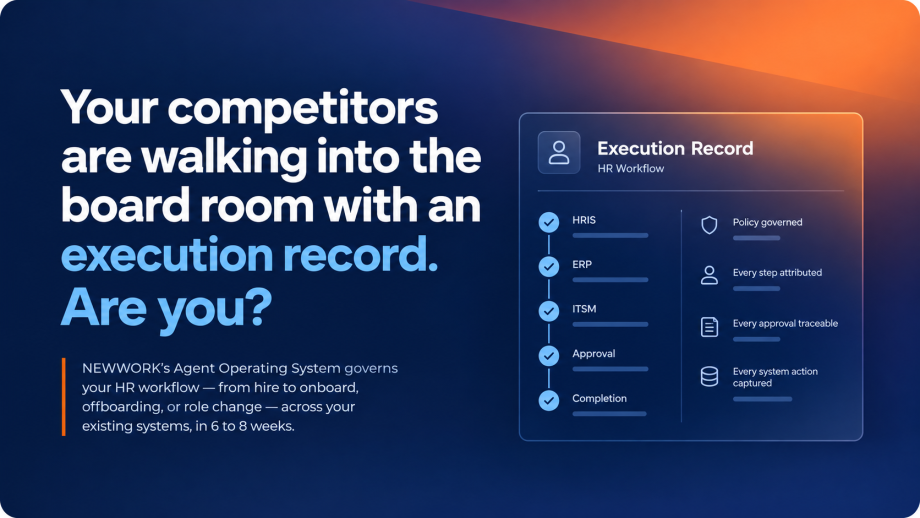
A FLOW execution record. Every step the workflow ran, which system each action touched, which policy governed it, which human owned the decision when one was required, and the reasoning behind each decision written in natural language rather than log output. Set against the baseline NEWWORK captured before anything ran, it is a measured before and after. It survives a board question, an audit, and a regulatory review. One document, read three ways. Your CFO reads return. Your CEO reads scope evidence. Your board reads audit trail.
What does not change.
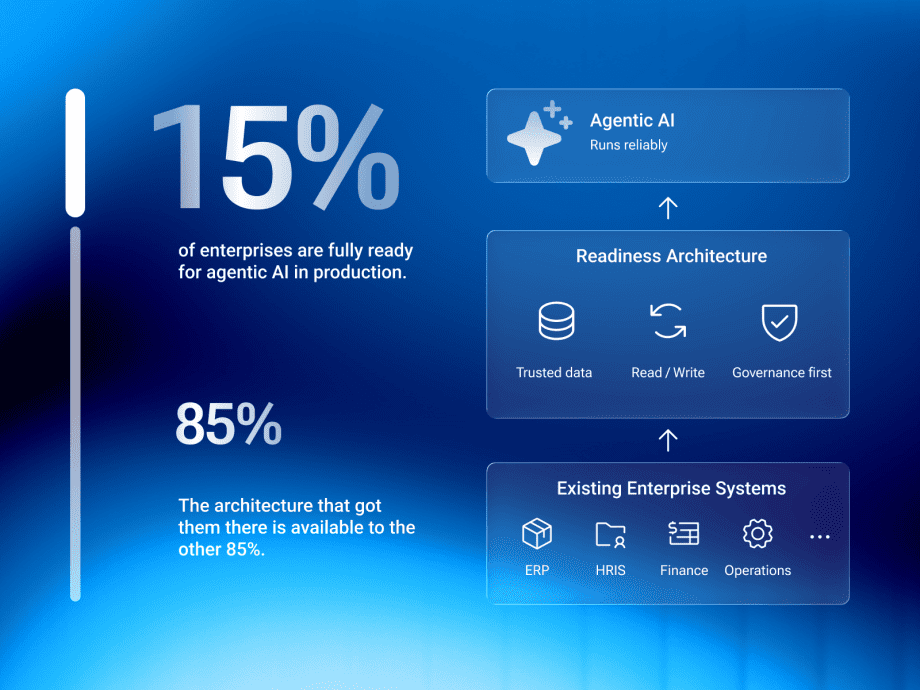
Your Systems of Record stay. NEWWORK Connect operates above your current landscape without requiring replacement, and your existing configurations and integrations remain as they are. Your roles stay. There is no parallel security infrastructure, because Digital Employees inherit the access rights of the department they operate within. What NEWWORK removes is the manual coordination work of moving information between systems that were never designed to connect, not the judgment work your team was hired for.
The first thirty minutes.
– You name the systems and how each connects.
– NEWWORK puts two or three candidate workflows on the table, with the architectural reason for each.
– You confirm which one to run, or tell us none of them fit. If the fit is wrong, this is where it becomes clear, which costs both of us less than finding out in week four.
– NEWWORK proposes the baseline method, and you agree it before it is measured.